Mt.Mera peak climb (6476M)

Welcome to Gurla Mandata

Mt. Mera peak climb (6476m)

 Mt. Mera peak climb (6476m). Mt. Mera peak is 6476 m high from sea level and it is permitted trekking peak in Nepal. Moreover, it stands to the south of Mount Everest. And it also dominates the watershed between heavily wooded valley of the Inkhu. J.O M Roberts & Sen Tenzing made the first successful summit of Mera peak on 20 May 1953. Therefore, the route they used is still standard and people follow it..,

Moreover, Mount Mera peak is one of the most popular trekking peaks of Nepal. Furthermore, the walk from Lukla through the Sherpa community of the remote Inkhu valley is an unforgettable experience. It also offers superb scenery and abundant wildlife. It includes rumored sightings of the legendary yeti also..,

Therefore, Mount Mera peak climbing is an easy trekking peak in Nepal. Also, you can do sky diving from the top. You can also see Mount Everest, Mount Makalu, Mount Kanchanjunga, etc from the top of Mera peak. Similarly, you can get the view of Mount Lhotse as well as many other tiny mountains. So, when the climber reach the top of mount Mera peak, they feel like they’re in heaven.,,

Hence, about 700 to 1000 Nepali guides and mountaineers climb Mera peak every year. Furthermore, it requires permit from the Nepal Mountaineering Association and mountaineering skills. Peak climbing

SAFETY     KITS:

1. Also, never trek alone. So, hire a guide if you can’t find companion.

2. Choose trekking companies/guides with eco friendly concepts.

3. Also, become informed about high altitude sickness.

4. And also, always carry a good medicine kit.

5. Hence, watch where you are walking. Don’t step backward blindly while taking photos.

6. Therefore, time your trek generously. Also, taking rest while trekking is not a sign of weakness.

Therefore, the trip cost will vary depending on the group size, duration of days and services required. Please contact us via our email. gurlamandatatrek@yahoo.com  Along with your details to obtain a quote.

Mt.Island Peak Climbing with Everest Base Camp Trek (6160m).

Mera peak with Amphulapcha La Pass and island Peak (6654m). 

Gurla mandata trekking 

Available departures

  • Day 01: Arrival in Kathmandu and transfer to hotel BB
  • Day 02: Prepare climbing permit, arrange all hotel
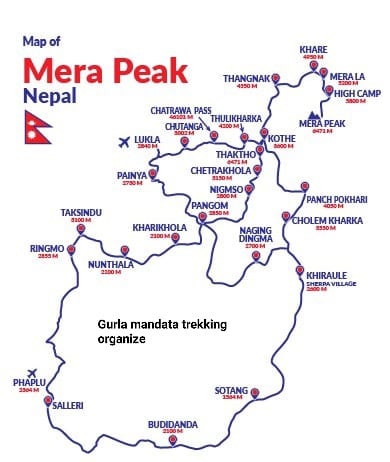
  • Day 03: Fly to Lukla and trek to Chutanga  – lodge 
  • Day 04: Trek - Zatra La 4600 m. Thuli Khark-lodge
  • Day 05:  Thuli Khark-Kothey village 3090 m.-lodge
  • Day 06: Kothey to Thangnak  4355 meters - lodge
  • Day 07: Thangnak  to Khare  5095 meters – lodge
  • Day 08: Khare Rest  day  for acclimatizing – lodge
  • Day 09: Khare – High Camp 5800 meters camping
  • Day 10: H.C. -  Mera peak summit 6476 m- back to Khare 
  • Day 11: Trek from Khare to Kothey village - Lodge
  • Day 12: Kothey – Chatrarbu (Thuli Khark) – Lodge
  • Day 13: Chatrarbu (Thuli  Khark) to Lukla – Lodge
  • Day 14: Fly Lukla – Kathmandu & transfer to hotel BB
  • Day 15: Transfer hotel to airport for final departure
  • INCLUDES
  • • 3 nights hotel in Kathmandu with bed & breakfast 3 star hotel BB.
  • • Climbing Permit for Mera Peak 6654m.
  • • Arun & Barunt national park permit
  • • All meal during the trek best available lodges / tea house
  • • 1 experience climbing Sherpa guide
  • . Climbing  SHERPA insurance  cost  250 USD per  guide Sherpa.
  • .Garbage deposit  250 USD.
  • • Climbing Rope, climbing food, climbing tent for high camp
  •   .  Guide  porter equipment
  • • 1 Climber 15 kg allowed weight for climbing equipments
  • • Kathmandu – Lukla – Kathmandu flight with 15 kg cargo
  • • Life & medical insurance for guide & porter
  • • All accommodation during the trek best available guesthouse
  • • Airport -hotel-airport transfer in Kathmandu
  • • Farewell dinner with Nepali dance & song
  • • Our service charge
  • cost
  • • Personal climbing equipment
  • • Personal Insurance for travel to Nepal
  • • Lunch & dinner in Kathmandu
  • • Emergency Rescue evacuation
  • • Personal expenses
  • • Tipping (Tips) for staff .
  • • Bar & beverage bills
  • • any extra charges no mention
01  Pax  USD  2500 guide +porter Fully package  includes  15 day
02 Pax  USD  2000 per  person  guide + porter Fully package including
04 Pax USD   1750 Per  person  guide+ porter Fully  Package  Including
06 -10 pax  1690 per  person  guide+ porter Fully package  Including
More then  6 client  2 climbing guide
   

Mt. Mera peak 6476m.

Mt. Mera peak 6476m.

Mt. Mera peak 6476m.


About destination Mt. Mera peak 

To get to Mera Peak from Kathmandu, you must first take a scenic flight to Lukla, which takes about 45 minutes. From there, you will trek east through valleys and villages, with a typical itinerary taking 14 to 21 days to complete the climb to the summit at 6,476 meters. Key points on the trekking route include Paiya, Khare (where acclimatization occurs), and Mera Peak Base Camp before the final ascent. 

Mt.Mera Peak is located in the Khumbu region of Nepal, specifically in the Mahalangur Himalayan range and within Sagarmatha National Park. It is part of the Barun sub-section of the Himalayas.
Region: Khumbu region, Solukhumbu District
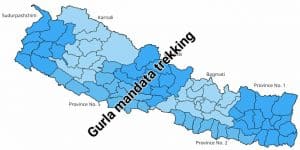
Province: Province 1, Nepal
Specific location: Mahalangur range, near Mt. Everest
National Park: Sagarmatha National Park and Makalu Barun National Park.


www.gurlamandatatrekking.com

Gurla mandata trekking 

map of mt. Mera peak


Read more

Equipments

  • Important documents and items
  • Valid passport, 2 extra passport size photos, airline tickets, Separate photocopies of passport, visa form (easily obtained at Kathmandu airport), proof of insurance, Dollars in cash for purchasing, Nepalese visa at Kathmandu airport, Credit cards, bank/ATM/cash machine cards for withdrawing funds from cash machines (bring a photocopy of your cards)
  • Personal Climbing Gears: Ice axe Crampons Harness Tape slings (2) Screw gate karabiners (2 lock, 2 unlock) Descender/eight figure Plastic mountaineering boots Ascender/Jhumar Helmet
  • Group Climbing Gears: Snow bar* Rope* Ice hammer* Ice screw*
  • Head
  • Bandana or head scarf, also useful for dusty conditions Warm hat that covers your ears (wool or synthetic) Headlamp with extra batteries and bulbs Sunglasses with UV protection Prescription sunglasses (if required)
  • Upper Body
  • Polypropylene shirts (1 half sleeve and 2 long sleeves)
  • Light and expedition weight thermal tops
  • Fleece wind-stopper jacket or pullover
  • Waterproof (preferably breathable fabric) shell jacket
  • Down vest and/or jacket *
  • Gore-Tex jacket with hood, waterproof and breathable.
  • Hands
  • 1 pair of lightweight poly-liner gloves
  • 1 pair of lightweight wool or fleece gloves
  • 1 pair of mittens; consists of
  • 1 Gore-Tex over mitt matched, waterproof, polar-fleece mitt liner.
  • Lower Body 
  • Non-cotton underwear briefs
  • 1 pair of hiking shorts
  • 1 pair of hiking trousers
  • 1 pair of lightweight thermal bottoms
  • 1 pair of fleece or woolen trousers
  • 1 pair of waterproof shell pants, breathable fabric
  • Feet 2 pairs of thin, lightweight inner socks 2 pairs of heavy poly or wool socks 1 pair of hiking boots with spare laces (sturdy soles, water resistant, ankle support, “broken in”) 1 pair of trainers or running shoes and/or sandals Cotton socks Gaiters
  • Sleeping 1 sleeping bag 30 degree DC Fleece sleeping bag liner
  • Rucksack and Travel Bags
  • 1 medium rucksack or 1 large duffel bag *
  • Day pack/backpack of 35 to 50 liters for carrying your valuables, should have good shoulder padding Small padlocks for duffel-kit bags
  • 2 large waterproof rucksack covers (optional)
  • Medical Small, personal first-aid kit (simple and light) Aspirin, first-aid tape, and plasters (Band-Aids) 1 skin-blister repair kit Anti-diarrhea pills Anti-headache pills Cough and/or cold medicine Anti-altitude sickness pills: Diamox or Acetylzolamide Stomach antibiotic: Ciprofloxacin, etc. Note: Do not bring sleeping pills as they are a respiratory depressant! Water purification tablets or water filter 1 set of earplugs Extra pair of prescription glasses, contact lens supplies
  • Practical Items 1 small roll of repair tape, 1 sewing-repair kit 1 cigarette lighter, 1 small box of matches 1 compass or GPS(optional) 1 alarm clock/watch 1 digital camera with extra cards and batteries Large Ziplocks 2 water bottles (1 liter each) 1 small folding knife Binoculars (optional) 4 large, waterproof, disposable rubbish sacks.
  • Toiletries 1 medium-sized quick drying towel Toothbrush/paste (preferably biodegradable) Multi-purpose soap (preferably biodegradable) Deodorants Nail clippers Face and body moisturizer Female hygiene products Small mirror
  • Personal Hygiene Wet wipes (baby wipes) Tissue /toilet roll Anti-bacterial hand wash
  • Extras/Luxuries Reading book Trail map/guide book Journal and pen iPod Travel game i.e. chess, backgammon, scrabble, playing cards (to help you pass the time at tea houses and/or camps) 1 modest swim suit Binoculars (optional) Voltage converter (from 220 to 110 ampere) Plug adapter (2 round pegs to 2 flat pegs) Lightweight pillow case (in case your tea houses provide you with pillows) or use your own stuff as a pillow.