
Welcome to Gurla Mandata
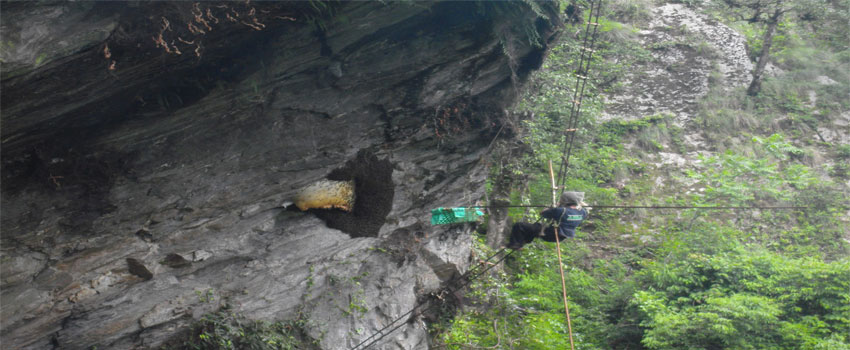
Nature & Honey Hunting Trek Nepal Tour. Twice a year high in the Gurla Mandata Trek foothills of central Nepal. The teams of men gather around cliffs. Also they are home to the world’s largest honeybee, Apish laborious. Furthermore, the men come to harvest the Gurla Mandata trek cliff bee’s honey. The harvest ritual begins with a prayer and sacrifice of flowers, fruits, and rice. Moreover, it varies slightly from community to community . Then, a fire is lit at the base of the cliff to smoke the bees from their honeycombs.
From above, a honey hunter descends the cliff harnessed to a ladder by ropes. As his mates secure the rope and ladder from the top. And ferry tools up down as required. Then, honey hunter fights territorial bees as he cuts out chunks of honey from the comb. A chance to view and experience the traditional honey hunting harvest of the Gurung people. The Bees Apia laborious and Apish dorsal are indigenous to the region. Also, traditional methods of harvesting the honey on steep cliffs are not changed for generations.
The introduction of non indigenous plant species and the European honey bee Apish mellifluous have put pressure on these local bees to compete, and they need to fly further and further to forage their preferred plant species. This along with over harvesting has resulted in the bees’ decline. The Himalayan Honeybees project for the International Center for Integrated Mountain Development in Kathmandu has been actively involved in the sustainable management of honey hunting and work with the local communities to ensure the survival of the species. Tourism in this area helps communities protect the flora and fauna, and so gives the bees and local hunters a chance to co-exist and continue.
Honey hunting techniques :
“Each area has its own distinctive style of honey hunting to suit local resources and bees. The basic method of lighting fire under the bee cliffs to smoke the bees from the combs appears to be universal. However, sociology-cultural and spiritual practices carried out prior to hunting honey are quite different from community to community. A group of about a dozen men-with ropes, ladders, poles, baskets and pots proceed to the cliff.
First, a worship and sacrifice is performed and cliff god is offered with flowers, fruits and rice grains. At the base of the rock a fire is made from wood and foliage, so that the smoke rise to disperse the bees upwards from the lower edges of their combs, leaving the brood and honey sections of the combs clearly visible. A ladder is suspended from the top of the cliff, tightly secured to trees at both upper and lower ends.
Honey hunter is fastened to the ladder by a rope and descends the rope ladder while others at the top of the cliff make sure that the rope is held securely. Two to three persons are responsible for checking, raising and lowering the rope to send items down from above and pull items up from the floor as necessary. One person, who perches on overhanging tree, looks the event carefully and gives signals to others. Near the ladder a large woven collecting basket is lowered to the nest site through another rope. When the honey hunter gets near the nest to be harvested, he uses a long stick to balance the collecting basket exactly under the comb. Its base is guided by a rope held by the people at the base of the cliff.
First the brood portion of the comb is separated. The honey hunter uses a bamboo stick to pierce a hole in the brood comb area of the colony to be harvested. By piercing the comb and attaching hook to the comb, honey hunter cuts the brood portion of the comb safely. After that, wooden or iron sickles fixed to the bamboo stick cut honeycombs. Basket is guided to catch the chunks of honey as they drop down. When full, the basket is lowered down to the ground, emptied and used again. The whole operation from start to finish is very delicate. It may take 2-3 hours or more just to harvest one of the many colonies.
Safety Tip:
1. Never trek alone. So, hire a guide if you can’t find companion.
2. Choose trekking companies/guides with eco friendly concepts.
3. And get information about high altitude sickness.
4. Also, carry a good medicine kit.
5. Watch while you are walking. And, don’t step backward blindly while taking photos.
6. Therefore, time your trek generously. Also, taking rest while trekking is not a sign of weakness.
Therefore, the cost will vary depending on the group size. More duration of days and services required. Please contact us via our email gurilamandatatrek@yahoo.com with your Details to obtain a Quot. Gurla Mandata Trekking